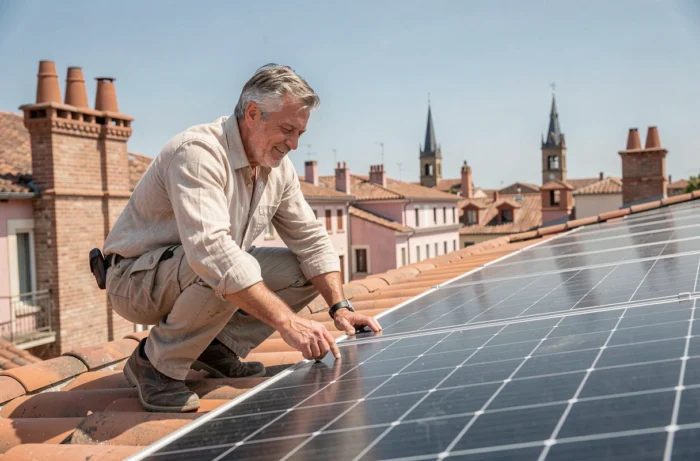
The energy efficiency of a house in Toulouse through solar power is no longer just about installing panels and selling the surplus. Since the tariff decree of June 1, 2026, the purchase price for surplus energy has dropped to 1.1 euro cent per kWh, and the self-consumption bonus has been eliminated for new connection requests up to 9 kWc. The profitability calculation now relies almost entirely on the share of electricity consumed on-site.
June 2026 Tariff Decree: What Changes for Residential Solar in Toulouse
The regulatory framework has shifted in just a few months. The decree published in the Official Journal on June 4, 2026, modifies two crucial parameters for any residential photovoltaic project.
| Parameter | Before June 2026 | Since June 2026 |
|---|---|---|
| Self-consumption bonus (up to 9 kWc) | Paid over 5 years | Eliminated for new requests |
| Purchase price for surplus | Variable by quarter, significantly higher | 1.1 c€/kWh |
| Reduced VAT (5.5 %) | Not applicable to photovoltaics | Available under conditions since October 2025 |
The direct consequence: selling surplus energy now only covers a marginal fraction of the installation cost. Profitability relies on the self-consumption rate, meaning the portion of solar production actually used by the household at the time it is produced.
A point of caution often overlooked: it is the date of submission of the complete connection request to Enedis that determines the applicable regime, not the date of signing the quote. Signing a contract before a regulatory change is not enough to preserve the old conditions. For ongoing projects in Toulouse, you can learn more at Habitat Expo about the steps to anticipate.

Solar Self-Consumption in Toulouse: Targeting Base Consumption
The sunshine in Toulouse, among the highest in mainland France, promotes photovoltaic production. However, it is not the amount of energy produced that determines actual savings, but the synchronization between production and consumption.
The Electrical Background Noise as the Main Lever
Each household maintains a constant consumption, even in the absence of occupants: refrigerator, internet box, standby devices, roller shutters. This base consumption, often underestimated, is the primary target of a well-sized installation.
- An oversized system produces a massive surplus, now bought back at a nearly symbolic price, which significantly extends the return on investment
- A system calibrated to base consumption increases the self-consumption rate and tangibly reduces the bill each month
- The addition of a storage battery remains subject to a different VAT rate than that of the panels, which alters the overall financial calculation
Proper sizing requires a prior analysis of hourly consumption curves, not just the available roof area.
5.5% VAT: Real Eligibility Conditions
Since October 1, 2025, the reduced VAT rate of 5.5% applies to residential photovoltaic installations up to 9 kWc, under several cumulative conditions: the housing must meet certain criteria, electricity must be used locally, equipment must comply with specific technical characteristics, and the intervention of a qualified professional is required.
Storage batteries do not automatically benefit from this reduced rate. This distinction impacts the total budget of a project combining panels and storage.
Collective Self-Consumption in Occitanie: An Emerging Model
Residential solar in Toulouse is no longer limited to the classic scheme of an individual house connected to the grid. Collective self-consumption is progressing in Occitanie, documented by the regional network TOTEn, which publishes feedback on operations involving multiple consumers around the same production source.
This model pools installation costs and smooths out consumption discrepancies among participants. A household absent during the day benefits from the production of a neighbor who consumes little in the evening. Thus, the overall self-consumption rate of the group exceeds that of each participant taken individually.
For condominiums or housing developments in Toulouse, this avenue deserves a feasibility study, especially as regional feedback is beginning to provide actionable data on actual gains.
Comprehensive Energy Renovation: Solar Alone is Not Enough
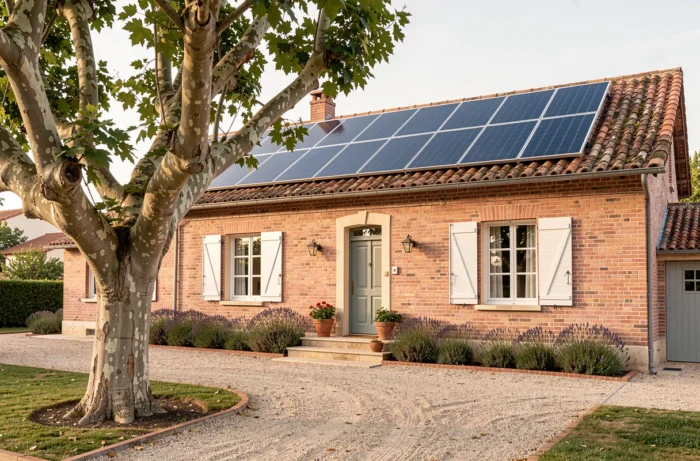
Installing photovoltaic panels on a poorly insulated house is like filling a bucket with holes. Insulating the attic and walls can represent about 30% energy savings, a gain that directly amplifies the effect of solar by reducing the total volume to cover.
The complementarity between thermal insulation and solar production works both ways. The less the house consumes, the more the self-consumption share increases, and the less significant the surplus (which is poorly compensated) becomes. Replacing an old heating system with a high-performance model can generate additional significant savings on electricity and heating bills.
In Toulouse, where summers are hot and air conditioning needs are increasing, good insulation also reduces summer consumption, a period when solar production is at its peak. This seasonal coincidence makes the coupling of insulation and solar particularly relevant in Haute-Garonne.
The regulatory framework of 2026 pushes residential solar projects towards a logic of maximum self-consumption. In Toulouse, this means precisely sizing the installation, coupling the work with building insulation, and checking the submission date of the Enedis file before committing. Collective projects offer a credible alternative for configurations where individual self-consumption is capped.