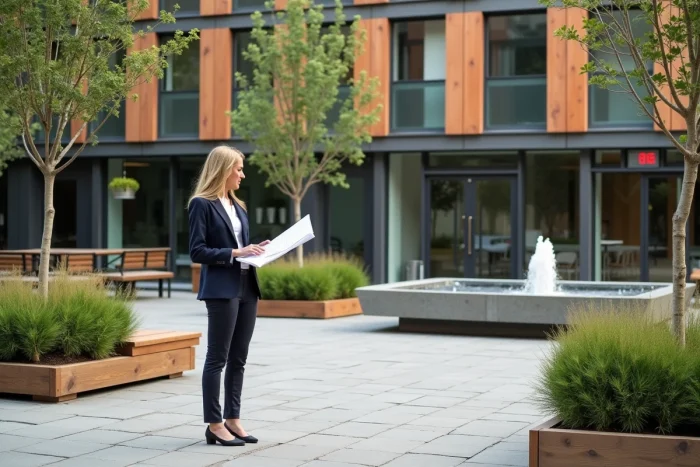
French cities still consume considerable areas of natural and agricultural land each year. The Climate and Resilience Law has reaffirmed the goal of zero net artificialization, which requires local authorities to rethink their urban planning in depth. The question is no longer just about building less far away: it concerns how to transform what already exists, reconciling quality of life, climate adaptation, and the aesthetics of public spaces.
Deimpermeabilization of Urban Soils: The Underestimated Lever of Planning
The greening of cities has been in the media spotlight for several years. Trees planted along avenues, planters in squares, green roofs: these interventions are visible and popular. However, they remain insufficient if the ground beneath our feet continues to prevent water from infiltrating.
The deartificialization of soils represents a paradigm shift. It is no longer about adding green to concrete, but about removing the concrete itself to restore the natural absorption capacity of the land. This approach simultaneously addresses runoff during intense rainfall events, groundwater recharge, and thermal comfort during heatwaves.
Several local authorities have begun to strip schoolyards, oversized parking lots, and mineral squares to replace them with permeable surfaces. Projects documented by ADEME and Cerema show that the renaturation of these spaces restores ecological continuities that had been disrupted by decades of urbanization. Initiatives accessible on designenville.fr illustrate how urban design can support this transformation without sacrificing the functionality of places.
Field feedback varies on one point: the durability of permeable surfaces in a continental climate, where freeze-thaw cycles put porous materials to the test. The technical choice strongly depends on the local context, and no universal solution is imposed at this stage.
Public Space and Active Design: When Urban Planning Becomes a Health Tool
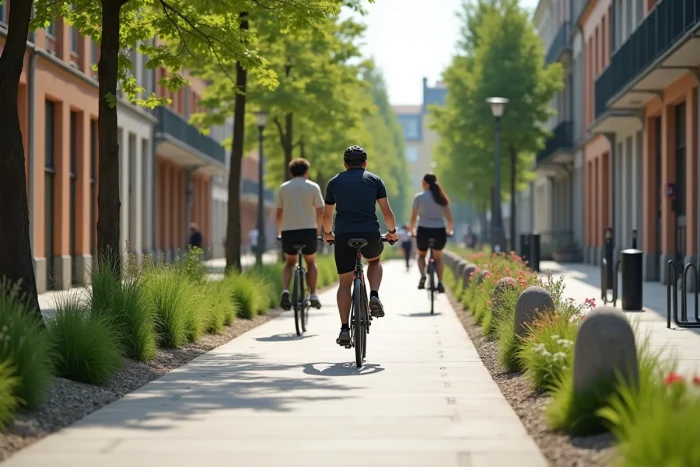
Cerema has developed the concept of active design applied to public spaces in recent years. The principle: to design squares, sidewalks, and parks that spontaneously encourage users to walk, sit, play, or interact, without the need for signage or event programming.
This approach shifts the focus from pure aesthetics to measurable quality of use. A well-oriented bench, a surface with varied textures, a gentle slope that invites walking: these micro-design decisions directly influence the time spent outdoors and, by extension, the physical health of residents.
Active design also raises the question of accessibility. A design intended to encourage movement can become an obstacle for people with reduced mobility if slopes, materials, or elevation changes are not calibrated. The aesthetics of a public space is also measured by its inclusivity.
What Active Design Changes in Practice
- Floor coverings alternate between soft and hard zones to modulate uses (play, rest, circulation) without partitioning the space with physical barriers.
- Urban furniture is positioned to create intuitive pathways rather than static zones, increasing pedestrian traffic.
- Vegetation plays a specific functional role (oriented shading, windbreak, acoustic filter) instead of being arranged solely based on decorative criteria.
Reuse of Built Structures and Land Use Sobriety: Building the City on the City
The goal of zero net artificialization pushes territories to look at their built heritage differently. Industrial wastelands, vacant offices, abandoned shops in city centers represent a considerable land resource. Rehabilitating existing buildings often costs less than demolishing and rebuilding, provided that structural diagnostics and potential soil decontamination are managed.
ADEME emphasizes this logic of land use sobriety as a pillar of the ecological transition of territories. Rather than expanding the peripheries, the most advanced urban planning projects transform parking lots into housing, warehouses into cultural spaces, and obsolete commercial areas into mixed neighborhoods.
Urban Wastelands: Potential Under Regulatory Constraints
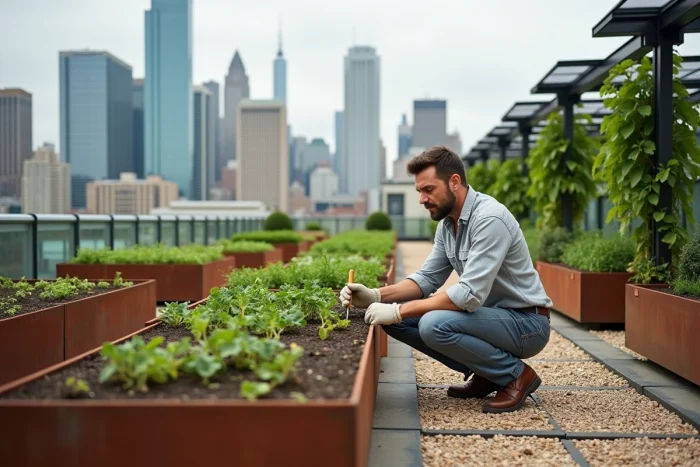
The conversion of wastelands faces concrete obstacles. Polluted soils require long and costly studies. Land ownership is sometimes fragmented among several public and private actors. Local urban planning regulations do not always allow for the change of use of existing buildings.
The available data do not allow for a precise quantification of the number of mobilizable wastelands at the national level. Estimates vary according to the criteria used (vacancy, pollution, accessibility). This ambiguity complicates planning and hinders local authorities that wish to accelerate.
Climate Adaptation of Cities: Cooling Rather Than Just Greening
The increase in heatwave events has evolved the discourse on sustainable cities. The challenge is no longer just to green urban spaces, but to cool them effectively. The nuance matters: a poorly positioned tree or a species unsuitable for the local climate provides only marginal benefits.
Combined solutions are gaining ground in recent planning projects:
- Coupling the deimpermeabilization of soils with vegetated swales that store rainwater and release it through evaporation during hot periods.
- Orienting streets and buildings to promote air circulation, relying on microclimatic modeling.
- Using high albedo materials (light surfaces that reflect solar radiation) on roofs and pavements to limit heat accumulation.
- Integrating fountains and water features in public spaces, not as decorative elements, but as cooling devices sized according to local temperature peaks.
This approach to integrated urban resilience requires coordination among urban planners, climatologists, and water network managers that goes beyond the siloed working habits of municipal services.
Rethinking urban planning means accepting that the beauty of a public space is not decreed by a choice of furniture or plant palette. It results from technical decisions about soils, materials, air and water flows. Cities that are making progress on these issues are not seeking to beautify their surface: they are restructuring what happens beneath.