A functional home is not just a list of purchases room by room. The equipment that truly changes daily life is related to regulatory safety, energy management, and air quality, three areas that most layout guides gloss over.
Smoke and Carbon Monoxide Detectors: Obligations and Regulatory Gray Areas
The autonomous smoke alarm (DAAF) remains the only detection device mandated in French homes. Decree No. 2025-518 of June 11, 2025, amended the wording of the Construction and Housing Code, without requiring connectivity. The technical requirements focus on CE marking and compliance with the NF EN 14604 standard.
We recommend checking the manufacturing date engraved on the casing. Replacing the entire device rather than just the battery reduces the risk of false negatives related to sensor aging.
The carbon monoxide detector, on the other hand, is not mandatory in homes in France. The DGCCRF confirmed this in a survey published on March 3, 2025. Its installation remains relevant as long as a combustion appliance (gas boiler, wood stove, insert) operates in the home. To find all the equipment on Be At Home, including home safety devices, the selection covers these two categories of detectors.
Connected Thermostat and Room-by-Room Heating Control
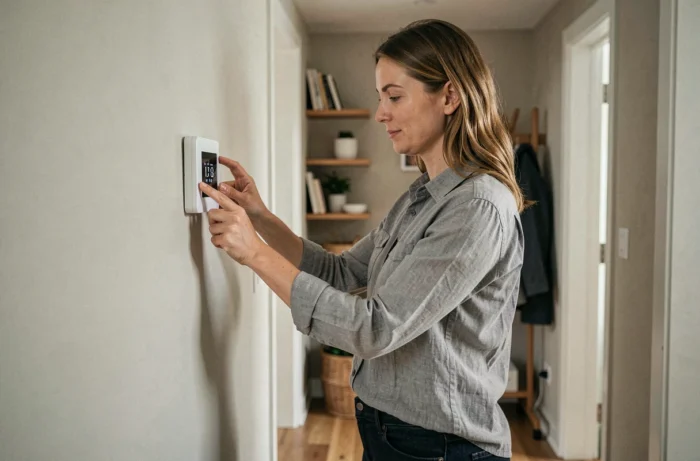
Zone heating control is set to become a regulatory standard. Decree No. 2025-1343 of December 26, 2025, establishes the obligation starting January 1, 2027, for new homes, with a postponement to January 1, 2030, for existing ones. Anticipating this deadline allows for spreading out the installation cost while benefiting from current subsidies.
Beyond the regulatory constraint, the connected thermostat adjusts the temperature to the actual occupancy of each space. The kitchen and living room do not have the same thermal needs as a bedroom occupied only at night.
Criteria for Choosing a Connected Thermostat
- Compatibility with the existing heating system (boiler, heat pump, electric radiators with pilot wire): no thermostat is universal; the communication protocol must be verified before purchase.
- Number of zones managed: depending on the models, the capacity varies. Ensure that the proposed number of zones covers all the rooms to be controlled individually in your home.
- Interoperability with aid devices: MaPrimeRénov’ and energy savings certificates (CEE) are cumulative for the installation of a regulation system, provided that a RGE professional is involved.
We observe that many homeowners install a central thermostat without connected thermostatic valves on each radiator. The energy savings remain limited: room-by-room regulation requires a sensor or valve for each heat emitter.
Indoor Air Quality: Ventilation and Controlled Renewal
Mechanical controlled ventilation (VMC) rarely appears in lists of household equipment. However, it is one of the devices that most impacts respiratory comfort and the preservation of the building. A hygroscopic single-flow VMC adjusts the extraction rate to the humidity level of each wet room (kitchen, bathroom, toilet).
A poorly maintained VMC degrades air quality instead of improving it. Dirty extraction vents reduce airflow and promote mold. Regular cleaning of the vents and filters is a simple technical gesture that contributes to the proper functioning of the system.
Single-Flow or Double-Flow VMC
The double-flow system recovers heat from the extracted air to preheat the incoming fresh air. It is justified in very airtight new constructions, where natural renewal is almost nonexistent.
In renovations, the installation cost of the duct network and the bulk of the unit often make the hygroscopic single-flow system more relevant.
Power Strips and Electrical Safety: An Underestimated Risk
An overloaded power strip heats up without visible warning to the melting point of the insulation. Daisy chaining, although common, exposes one to a real overheating risk.
We recommend prioritizing power strips equipped with a master switch and surge protection, especially for computer stations and audiovisual equipment. The maximum allowable power, indicated in watts on the label, must never be exceeded by the total of connected devices.
- Never plug one power strip into another: the conductor size is not designed for this cumulative load.
- Replace any power strip whose cable heats up to the touch or whose plastic shows discoloration.
- In damp rooms (laundry room, kitchen), position power strips off the floor to limit the risk of short-circuiting in case of water leakage.
Energy Renovation Aids: Combining MaPrimeRénov’ and CEE
MaPrimeRénov’ and energy savings certificates are based on different logics but remain cumulative for most heating and ventilation improvement works. The ceilings vary according to the household profile and the type of technical gesture performed: we recommend consulting the official guide to renovation aids in its most recent version before any commitment.
Equipping an energy-intensive home with a connected thermostat or a high-performance VMC is not enough to lift a potential rental ban but contributes to the necessary leap in energy class to improve the property’s label.
Combining the two aid devices requires a file submitted before the start of the work and the involvement of a RGE craftsman. Initiating administrative procedures before ordering equipment remains the only way to secure the amount of coverage.